The long read
The high cost of living in a disabling world
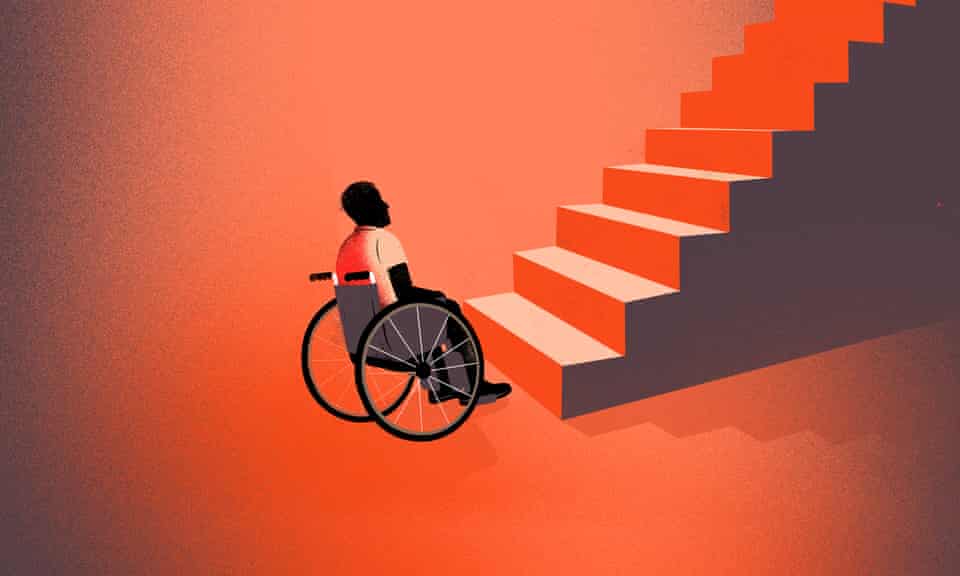
Illustration: Sébastien Thibault/The Guardian
For all the advances that have been made in recent decades, disabled people cannot yet participate in society ‘on an equal basis’ with others – and the pandemic has led to many protections being cruelly eroded
by Jan Grue
Thu 4 Nov 2021 06.00 GMT
At times, it feels as if the disability rights movement won. After years of groundwork, 1981 was declared the International Year of Disabled Persons. I was born that year, in Oslo, Norway, and though I did not receive my first diagnosis of muscular dystrophy until I was a toddler, the coincidence is apt enough: I was born into a world that was, at last, beginning to recognise this aspect of my being in it.
Then, from 1983 to 1992, came the United Nations’ Decade of Disabled Persons. And the Americans With Disabilities Act, the UK’s Disability Discrimination Act and the UN Convention on the Rights of Persons with Disabilities. The turn of the millennium was marked by a litany of good intentions and disavowals of unequal treatment – by an endorsement, as the first article of the UN convention has it, of disabled people’s right to “full and effective participation in society on an equal basis with others”.
Get the Guardian’s award-winning long reads sent direct to you every Saturday morning
I came of age in this world, more or less protected by these rights. In Norway, which produced its own act in 2008, I received an education, found work and started a family. I am writing this as a tenured professor, as well-protected as a member of a protected class can be. And yet I am writing with a feeling, as Tony Soprano had it, that I came in at the end – that the best, in the sense of our best and greatest hopes for universal, rights-based protections, and for the logic of anti-discrimination, is over.
Some protections have been eroded, usually in the name of budgetary constraints. I also suspect that the big conversation – about whether disabled people should have “equal rights” – has sometimes served to obscure the innumerable material inequalities that make up lived experience. And perhaps we need to have a different conversation in order to understand this world: the conversation about work.
The playground outside my son’s kindergarten is enclosed by a wooden fence that is about 1.5 metres high. The gate, also wooden, is opened with a sliding bolt placed at the very top – high enough to stop any enterprising toddler from escaping into the adjacent car park.
Advertisement
In order to open the gate, I have to raise the seat of my wheelchair as high as it goes, a full foot or so from its lowest setting. This allows me to stand up and reach the bolt. If it rains or snows, as it often does in Oslo, the wood expands and the bolt becomes hard to shift. I have to watch my balance, especially as I take a few steps out from my wheelchair in order to close the gate behind me; there is no way to do this while I’m seated.
For my son and me, this task has become a game and a joint effort. He helps push the gate open. Standing on tiptoe on the footrest of the wheelchair, he can reach the bolt himself, just about. He knows what we’re doing, and his part in it. It was tougher when he was three, and I didn’t want to shift my attention from him for even a second, with cars and trucks liable to enter the car park at any time.
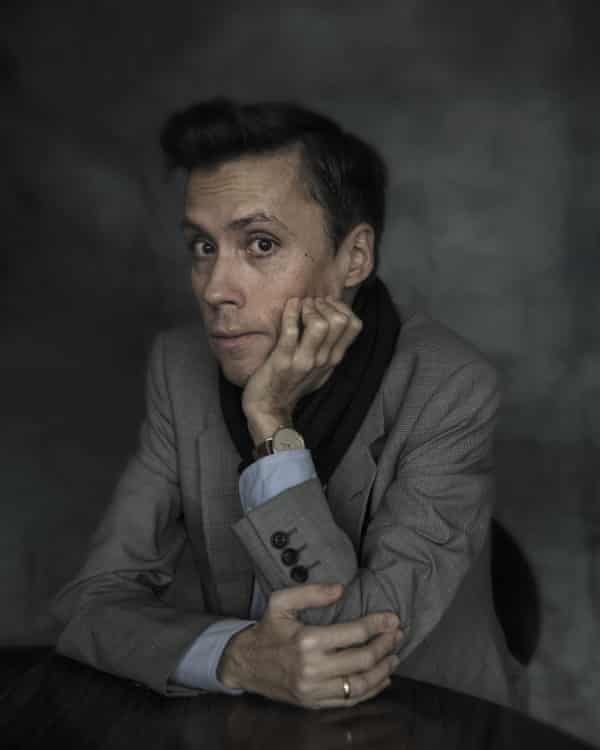
Jan Grue. Photograph: NTB Scanpix/Sipa USA
The gate is old. I wouldn’t mind seeing it replaced. But I’m hesitant to make a request. I’ve seen the new gates appearing at other kindergartens throughout the city, outfitted with a bolt that does not slide but has to be pushed up. My triceps and shoulder muscles are significantly weaker than my biceps. I have no way of opening these new gates on my own. And I want to take my son to kindergarten myself, for this very short, very long stretch of his life.
There are, of course, other parents. During rush hour in the morning and early afternoon, barely a few minutes pass without someone dropping off or picking up. This has given me, over the years, a range of social experiences at the entrance to the kindergarten. Some parents rushed to help open the gate from the first. Some seemed hesitant, but needed only a bit of encouragement – a nod, a smile, a “Would you mind … ” – and that would be enough.
In some encounters, though, there was only a kind of void. In these encounters, I knew with perfect clarity that if I wanted this person’s help, I’d have to ask for it, loud and clear. Direct gaze, firm voice. “Can you please open the gate for me?”
I don’t always have the surplus energy for this. I know that the physical effort I will expend in opening the gate is an order of magnitude larger than what I’m asking of this other person, who can slide the bolt effortlessly, push and pull the gate with barely a thought. But I also know that the physical effort I’ll be expending can be less strenuous than the emotional effort of saying the right words in precisely the right way.
The other parents are, as a group and as individuals, helpful and kind. They are social democrats and egalitarians. They believe in equality. At one time, my wife was talking to one of the other mothers in the kindergarten; they were talking about their lives. I came up, my wheelchair came up, and the woman, hesitantly, said that she hadn’t wanted to impose, by helping with the gate. She’d seen me, naturally, but she had a notion that it was important to see me as a person, not just the wheelchair. And so she had made a decision not to offer help.
The
UN Conventionon the Rights of Persons with Disabilities received its first signatures in 2007; it received the highest number of opening-day signatures of any such document. It has been called the last of the great human rights conventions, the last of the great acts of recognition for minorities previously ignored. (Although, of course, we will never be certain whether any such act is, or ought to be, the last of its kind.)
The convention is utopian, as it must be. The question is what kind of utopia it envisions: a world where human rights are extended fully and comprehensively to people with disabilities. A world in which disability discrimination has been eliminated.
What does this mean? What utopia does the goal of “full and effective participation in society on an equal basis with others” point towards? This depends not only on what we mean by discrimination, but also by equality.
The concept of equality is never more problematic than when it intersects with the concept of justice. Aristotle identified the core of the problem when he argued, in Politics, that “equality seems to be just and it is, but not to everyone, only to those who are equal to begin with”. Of course, this can be an argument in favour of economic redistribution, but also in favour of racism, sexism and many other forms of explicit discrimination, since “inequality seems to be just, and, indeed, it is, but not for all people, only those who are not equal”.
We do not, on the whole, argue this way. We try, on the whole, to sever equality in terms of value from equality in terms of capabilities. We want, in the postwar liberal tradition to which the great UN conventions belong, to achieve equality of opportunity, if not equality of outcomes.
The use of human rights as an instrument for achieving this goal has many merits, and a great moral weight. And the configuration of discrimination as the great moral evil of our time has come to influence even homogeneous and social democratic Norway. Here, too, the Anglo-American discourse of rights and discrimination has taken centre stage.
This has happened in my lifetime. Not even that; it has happened in my adulthood. But the change is pervasive enough to make me strain to remember what it has displaced.
What does it mean to eliminate disability discrimination? To identify and enumerate all of the ways in which society needs to be reconfigured?
Photograph: Martin Barraud/Getty Images
Advertisement
I took a swing at it once, earlier this year. I’d ordered a package from Amazon (I know), and it was forwarded, through UPS, to a fast-food-joint-cum-kiosk near my building. This place had steps, no ramp, and neither doorbell nor contact information available online. It was the third time UPS had rerouted a book there. I’d had no luck telling them that the place was inaccessible, and the people working at the pickup point were … less than sympathetic. And so I made an official complaint to the Norwegian authorities.
It’s tempting to recount the entire process in this essay, because it’s always tempting to make someone else live through your own experience of boredom and frustration. But I’ll exercise some restraint. Wheelchair users have to do that, or risk coming across as, well, bitter. Suffice it to say that after nine months of increasingly confusing notifications from the authorities, letting me know that I’d failed to supply the information they needed to make a judgment, they nevertheless judged in my favour. Reader, I have it in black and white: I’d been discriminated against.
The skies did not part, the chorus did not sing. Possibly because I was already fairly certain that I’d been discriminated against, possibly because this was one incident I could have picked out of a very large number of similar incidents. And so, while still believing fervently in the right not to be discriminated against, I prefer, for the moment, to focus on something else: having my invisible work, and the invisible work of disabled people in general, recognised as work.
In 1987, Arlene Kaplan Daniels, in an essay titled Invisible Work, developed a critique of the general understanding of work that placed this activity in a special sphere, set apart from the rest of life. Developing her analysis from earlier, feminist examinations of how domestic labour was gendered, disregarded and devalued, like Silvia Federici’s Wages Against Housework, Daniels used the term “invisible work” to refer to tasks that are done not only out of sight, but also out of mind. These were tasks that simply weren’t thought of as work, but as natural activities – what any woman should do voluntarily, happily and without compensation.
Crucially, in Daniels’ conception, invisible work had a physical and an emotional component. Such work included not only the cleaning, cooking and logistics involved in managing a household, but also the ultimate responsibility for the wellbeing of guests as well as other household members. The way these duties become framed as “natural” was part of a moral narrative in which women would succeed or fail at being women depending on the emotional reactions of others.
Advertisement
In this analysis, invisible work kept the social world and the capitalist economy running. Men were only able to work full shifts outside the home because women’s invisible work enabled them to do so, and the social role expectations of gender roles for men and women were similarly supported and maintained. The asymmetry of the power relations between genders are magnified in this way, as is the economic imbalance.
In many ways, Daniels’ argument applies directly to the invisible work imposed on disabled people by an inaccessible world. On the face of it, there is a significant difference: the invisible work of women is largely carried out for others, while the invisible work of disabled people is carried out for themselves. But this distinction is something of an illusion. First, disabled people are often women. And the burdens of invisible work tend to exacerbate or even create impairments and chronic illnesses. Second, invisible work that supports a particular way of being in the world is also work that supports a complex network of social relations. The salient question about disability and invisible work is therefore very similar to the one about invisible work and gender: what would the world look like if it was no longer carried out?
In my own case, my invisible work supports nearly every aspect of my social being, from my role as spouse and parent to my role as an academic and writer. I could not teach my students nor share the household responsibilities without these efforts; I could not fully be a part of my son’s life.
At home, my wife and I have done our best to share the invisible work as justly as possible, the standard being that we should both, at the end of the day, be equally tired. She can lift heavier things than I can; I can take on more of the logistical work of the second shift, remembering and planning for the dentist’s appointments and clothes purchases that are the warp and weft of parenthood.
Outside our household, things become more complicated, since I am not negotiating or collaborating with a single person, but with the world. I could withdraw, to an extent. I could resign from my university post and apply for disability payments, but this would not remove the need for me to maintain my existence with the multitude of tasks and errands that bring me into contact with inaccessible stores and venues, with service providers and government agencies.
The only way to escape this work, short of a utopian remaking of the world, is to stop living. Disabled people know this. They know that they have the right to access, in principle and in law, but that they must work, continuously, in order to claim this right. They know that this is because there are many institutions, and people, that would much prefer a world without disabled people in it. Not a world without disabling forces; a world without disabled people. And so the invisible work is, at heart, the high cost of living in a disabling world.
Advertisement
Accessibility may, as the disability scholar Tanya Titchkosky has pointed out, exist in much the same way as “diversity” does – for the sake of
bragging rights on the part of institutions, organisations and companies. If a few minority representatives are made visible, are included, then that serves as sufficient evidence that anti-discrimination policies have been put in place and are good enough.
However, in her wide-reaching argument about the political limits of non-discrimination, the academic and author
Amia Srinivasan invokes intersectional analysis, pointing out that discrimination “on the grounds of sex” is always easiest to identify in cases where sex alone can be used to distinguish between cases, ie in order to establish that “discrimination” has taken place. Consequently, a lack of inclusion may well persist for the vast majority of women. The more that other forms of political marginalisation are involved – having to do with poverty, racism or health – then the harder, and less relevant, it becomes to establish discrimination “on the grounds of sex”. A strategy for inclusion that benefits rich, white, non-disabled cis women is not necessarily a strategy that benefits all women. It may help a small subset of women gain power within existing structures, but it is highly likely to include those who are already the most privileged members of “their group” – homogeneously conceived, heterogeneous in practice.
This feminist argument, too, is sufficiently flexible that it applies to disability. It certainly applies to me. As a highly educated wheelchair user who also belongs to the ethnic-majority population in what is arguably the world’s richest welfare state, I have little doubt that I’ve personally benefited greatly, and more than most disabled people, from the disability field’s turn to the political logic of anti-discrimination. I am one of the privileged few; my status as a disabled person can very nearly be thought of as something external to me, situated in my wheelchair. If not for it (or rather, the reason I need it), I would be “like everyone else”. This was the logic that resulted in the UN Convention, and in the various national pieces of legislation. And although the laws have differing degrees of political bite, it cannot be denied that their existence has shifted the public discourse and, to an extent, public opinion. Discriminating against disabled people is, to a much greater extent than previously, not cool.
I know this because the world around me has changed as I have grown older. I remember a time in Norway when practically no one acted apologetically because of a lack of access; the problem was always me, the wheelchair user, and my unreasonable expectation of being let in. This is no longer true. There are even newly built areas of my city, Oslo, where I will show up at a venue without checking accessibility in advance – a risk I would not have taken even a decade ago. In the newest additions, I am spared the invisible work of mapping out routes, checking images online, making calls, writing emails. I am allowed, within the confines of this space, to trust the utopian claim that I will be allowed to participate fully and on equal terms with others.
Photograph: Mike Kemp/In Pictures/Getty
Advertisement
The space is small, however, and I could claim discrimination many times a day, if I chose to do so. Or could I? I return to the gate to the kindergarten, asking whether its existence discriminates against me. Yes, it is inconvenient for me to open – risky, even, in winter. It is not simply a gate, but a barrier – what the UN convention, for example, aims to do away with.
The UN convention, however, also has other concerns. First and foremost, it is concerned with providing “reasonable accommodation” – that is, forms of accommodation that do not impose “undue burdens” on others. The disadvantage imposed on me by a gate I cannot open must be weighed against the risk that an “undue burden” will be imposed on whoever would be responsible for replacing the gate with one that I can open. And so the question is never simply “Am I being discriminated against?” In practice, it is also “How much of my invisible work can reasonably be shifted on to society?”
This question inevitably brings us back to Daniels’ analysis of the moral frame that makes invisible work seem inevitable and natural. What constitutes a reasonable request is a moral issue. And so, for each of the hundreds of troublesome tasks that I encounter throughout the day, if I ask whether I’m being discriminated against, I must also ask whether I am being unreasonable. Whether I am, unreasonably, trying to evade the duties that follow naturally, inevitably, from having a body that cannot do the things that bodies should naturally be able to do.
But I don’t have the stamina to make these judgments for myself and for society. I don’t have the fortitude to ask what is reasonable or unreasonable, never mind to ask which entity is responsible and how to seek recourse. There is, quite simply, too much I have to do.
At times, I rally. At times, I believe that I am accepted and acknowledged. I have the credentials, and the privileges, of a white male academic, living in a rich country, travelling with a passport that is all but universally valid. At times, I can believe that my invisible work is, all things considered, negligible. That I am protected by the rights and the principles that were fought for over generations, that it is now merely an item of interest that I use a wheelchair.
It felt like that as I planned for a sabbatical in California, as I was interviewed at the American embassy in Oslo, as I filled out the visa application that requested very specific information about my health, information that could be used to assess the level of risk I would pose to the public health and financial wellbeing of the United States. As I glanced at the other people in the waiting room, many of whom did not have Norwegian passports or Norwegian privilege, it felt as though I was already on the inside, looking out.
Advertisement
And in California, in Berkeley, my family and I still felt ourselves to be in this privileged bubble. Although our invisible work was redoubled in this foreign country, where we could not draw on the help of friends or family, where I had to strain to adjust to a house that was less accessible than our apartment back home, it still felt as though I could not be touched. That I was doing this thing – living abroad, as a wheelchair user, a guest of the University of California – that would have been impossible not so very long ago.
It was January 2020 when we arrived. In February, it felt as if we had found our feet. As if we would soon be able to enjoy everyday life without a constant sense of strain, of always having too many unsolved tasks. As if our invisible work was paying off. And then came March.
Along with the sudden sense of acute risk, of danger everywhere, came a redoubled workload. With the kindergarten closed, with partly empty shelves at the supermarket, with public transportation gradually shutting down, every aspect of the day became a logistical challenge. From the day the pandemic became declared as such, on 11 March, we changed our minds constantly about staying or going, about whether we could manage. We’d hoped to stay until June, but in the end we caught the next-to-last plane leaving for Scandinavia from the east coast, on 28 March, the day I turned 39.
It wasn’t only the work, of course. Fundamentally, it was the fear of closed borders, along with the fear of disease and death. But these fears were hard to disentangle. I knew, with absolute certainty, that should I need to go to the hospital, my 180kg wheelchair would be left behind. Regardless of how my body would handle a Covid infection, I’d be helpless. I knew, too, that should my wife need to go to the hospital, and I were left behind with our toddler, I would barely be able to cope without outside help – which was no longer to be had.
All over the world, many people had similar experiences. The rights, of course, were nominally in place – rights to services, rights to support. But as disabled people across the world found out during the pandemic, the rights did not mean all that much when push came to shove. Not only did the rules of triage mean that during acute local crises, anyone with a chronic condition ran a higher risk of not receiving proper medical care, but the politics of the pandemic also meant that the physical needs of care went unmet – partly because resources were directed elsewhere, partly because public health measures could be invoked to dispense with services deemed too cumbersome or expensive. As Lennard Davis put it, in
an essay titled In the Time of Pandemic, the Deep Structure of Biopower Is Laid Bare: “In regard to disability, the ableism that puts on a compassionate mask in milder times now reveals its brutal face.”
Advertisement
My family and I were very, very privileged. We could pay for the plane tickets; we could go home. Norway didn’t exactly feel safe, but it felt infinitely safer than the US – and proved itself to be so over the time that followed, as the extreme vulnerability of disabled people became visible through sheer mortality rates. In crisis, the language of equal rights and anti-discrimination became that of utilitarianism and prioritisation. The invisible work did not become more visible. There was simply more of it, and even less justly divided than before. Economic inequality increased dramatically from March 2020 onward. So, perhaps, did moral inequality.
Iam writing this … why, exactly? Because, I think, I’ve had it with the pieties of neoliberal inclusionism. Because I’ve lost faith in our ability to put on the veil of ignorance – to construct the just utopia proposed by John Rawls, who thought we could best design a just world if we forgot our current social status, gender and religious beliefs, but who explicitly, as the philosopher Martha Nussbaum points out, excluded disability as an aspect of human diversity to be planned for in the New World.
I suppose it was just too hard to do that.
I am writing this because I am trying to reach back to a way of thinking that very nearly seems lost, though it was spelled out and fully developed around the time I was born; a way of thinking that allows work to be not the thing you get paid for, but, much more fundamentally, effort expended.
It is the shift from economics to physics – energy transferred from a body – though also, of course, from one economic mode to another. I am not, perhaps, generating surplus value when opening the gate to my son’s kindergarten. I am, however, keeping the household afloat. And myself. I am moving about in the world, continuing on my route to my actual work, the one where I’m comfortably seated in front of my computer, writing these lines – expending, by comparison, barely any effort at all.
The tyranny of chairs: why we need better design
And so, finally, I move from the gate to the kindergarten to the door to the building itself: also wooden, also heavy. In order to open it, I grab the latch with my left hand, using my right to very carefully guide the wheelchair backwards. My arms have limited range, since contractures in my muscles don’t allow them to stretch beyond a 45-degree angle. I can just about open the door to a point where I can guide the wheelchair forward again, forcing the door to stay open with my right front wheel, but it’s a matter of luck, or how tired I am, whether I succeed. Opening the door is not an automatic task, but something I repeatedly try and fail. And the day has hardly begun. I have a city to traverse, streets to cross, trams to ride, buttons to reach for. There will be much to do.
What does the utopian city look like, the one in which I participate “on an equal basis with others”? I have an inkling. I can envision the broad sidewalks and the spacious metro cars departing from perfectly level platforms. I can see, just about, the absence of barriers that are clearly barriers, leftovers from a time when being able to walk was an absolute requirement for citizenship. What I cannot see, cannot think into being, is a world where there is no greater effort required of me than of the average person, whoever they are. Where the difference between us is erased and I, driving my large, black, powered wheelchair, blend into the crowd.
Follow the Long Read on Twitter at
@gdnlongread, listen to our podcasts
here and sign up to the long read weekly email
here.