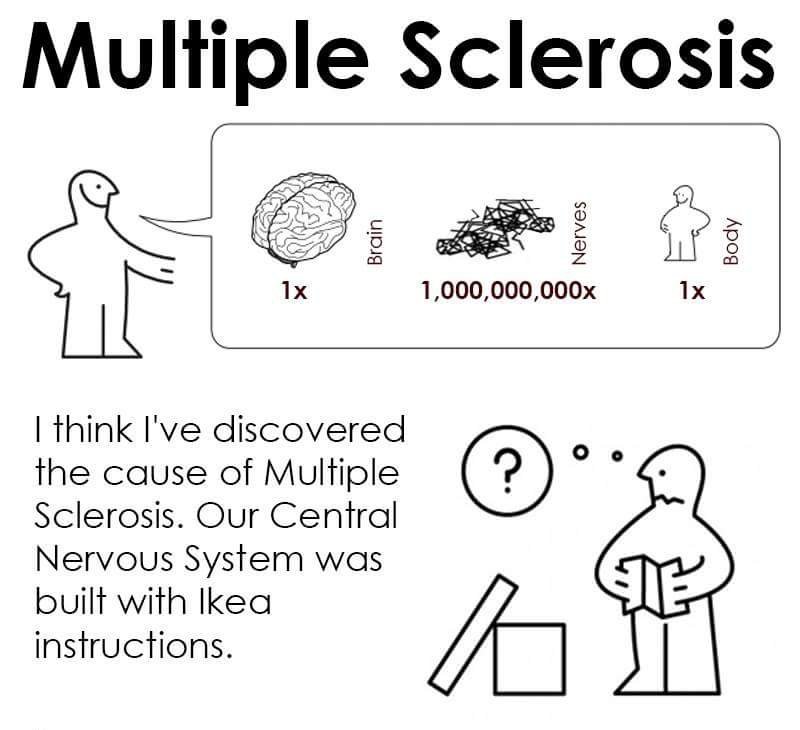
Sound familiar? Rare conditions often go unrecognized by the medical establishment.
Stay Positive
- Alert Camus
Friday, November 17, 2017
Monday, November 13, 2017
How bacteria in the gut influence neurodegenerative disorders
SfN: Neuroscience @SfNtweets
On her results: "[They] suggest that APOE alleles may differentially affect the gut microbiome...[contributing] to the actions of APOE in modulating Alzheimer’s disease risk."
Our last #SfN17 press conference of the day begins. Scientists will discuss how bacteria in the gut influence neurodegenerative disorders like #Parkinsons and #Alzheimers.
Tracy Bale of @ummedschool moderates.
On her results: "[They] suggest that APOE alleles may differentially affect the gut microbiome...[contributing] to the actions of APOE in modulating Alzheimer’s disease risk."
Friday, November 3, 2017
Stem Cell and other potential treatments
MS & ME Internet Radio : MS, The Edge Live now! Listen here: http://msandme.out.airtime.pro:8000/msandme_a - #ms #multiplesclerosis #CureMS #MSWarrior #MSNews
GeNeuro’s stock rose by 30% on Monday following an announcement of promising results from its relapsing-remitting multiple sclerosis drug, GNbAC1. After six months, the highest dose demonstrated an anti-inflammatory effect and seemed to stimulate remyelination.
“When we released topline results after 24 weeks in August, we communicated that we had missed the primary endpoint: the cumulative number of gadolinium-enhancing lesions,” Jesús Martin-Garcia, CEO of GeNeuro, told us. “At the time, we formulated a hypothesis that this could be led by the late onset of action.”
GNbAC1 is a monoclonal antibody that targets a pathogenic retroviral envelope protein that has been found in all types and stages of multiple sclerosis. By neutralizing this protein, they reduced lesions and inflammation in the brain. As Martin-Garcia described it, “We’re not directly impacting the immune system, like immunomodulating or immunosuppressive drugs. We’re neutralizing a pathogenic protein, so it may take longer for the effect to be seen on inflammatory markers.”

So far, GeNeuro’s approach verges on unique: “There’s a tremendous amount of literature coming up today about pathogenic HERV proteins from leading research centers,” said Martin-Garcia. “But in the clinic, we’re really the only company.” Some academic centers are trying to treat the disease with antiretrovirals, which is the same concept but different tool.
So with the positive news in hand, what’s next for GeNeuro? “We have encouraging data here. Hopefully, we can open new avenues by neutralizing causal factors of these diseases, to slow down or stop their progression,” said Martin-Garcia. “Now we have to confirm how GNbAC1 performs after 48 weeks.”
Curious? Hear more from the CFO of GeNeuro in our video interview.
Co-authored by Clara Rodríguez-Fernández
Images via Designua, ustas7777777 / shutterstock.com

Thursday, November 2, 2017
Tuesday, October 24, 2017
After an M.S. Diagnosis, an Emotional Return to the N.H.L. Ice
By PAT BORZI APRIL 5, 2017
The Hurricanes’ Bryan Bickell, left, pursued the Wild’s Matt Dumba on Tuesday night in St. Paul. Credit Jim Mone/Associated Press ST. PAUL — Fourth-line forwards like Bryan Bickell rarely draw much attention unless they mess up, especially on a night with so much pomp.
In a pregame ceremony on Tuesday, the Minnesota Wild honored the veteran Eric Staal before he participated in his 1,000th N.H.L. game. Then Staal started against the Carolina Hurricanes, his former team, whose lineup included his brother Jordan. So Bickell’s first shift for visiting Carolina went largely unnoticed.
But when Bickell, a journeyman left wing, hopped over the boards nearly two minutes into the game — his first N.H.L. appearance since Oct. 30 — he achieved an even rarer milestone. Bickell became the third player with multiple sclerosis to play in the league, and the first who was not a goaltender.
Bickell failed to score in Carolina’s 5-3 loss. His line, featuring center Andrew Poturalski in his N.H.L. debut, was on the ice for two goals in a freewheeling first period in which each team scored three times. But after two months of skating and a 10-game conditioning stint with Charlotte in the American Hockey League, Bickell, 31, felt as much relief as excitement to resume his N.H.L. career with four games left in the regular season.
“Emotionally, it was good to get back out there,” Bickell said, standing in a hallway outside the Hurricanes’ dressing room. “Obviously that first period wasn’t what we wanted as a line, but I think as the game went on it got better.”
Continue reading the main story
His teammates were thrilled to have him back. “It shows perseverance, mental toughness, everything,” said center Jeff Skinner, who leads Carolina with 35 goals. “It’s inspiring. For me, it’s cool to be a part of that and witness it firsthand.”
What happens from here is largely uncharted territory for Bickell, who was a part of three Stanley Cup championship teams with the Chicago Blackhawks before being traded to Carolina last summer. Blackhawks fans best remember him for his nine goals and eight assists in the 2013 playoffs, when Chicago won its second Cup in four years.
Multiple sclerosis is a chronic disease of the central nervous system, usually striking in early adulthood, with no known cure. Some people exhibit no symptoms at all. For others, it can be debilitating. Dr. Bruce A. Cohen, a professor of neurology at Northwestern University, said many patients with M.S. can function normally when the disease is diagnosed early and they are placed on proper medication.
“He combats the general picture that people may have when they think of this disease, that it always results in severe loss of function and inability to do things in life that people want to do,” Cohen, who has not treated Bickell, said in a telephone interview. “We’ve come a long way in the last two decades in terms of what we’re able to do for people when we’re able to treat them early and effectively.”
Bickell learned he had the disease in November, shortly after losing function in his right arm and leg during a morning skate. Before that, Bickell had been hampered for more than a year by an assortment of physical ailments, dating to the 2015 Stanley Cup finals with Chicago. His play suffered so much he languished in the minors for much of the 2015-16 season.
Newsletter Sign Up
Continue reading the main story
Sign Up for the Sports Newsletter
Get the big sports news, highlights and analysis from Times journalists, with distinctive takes on games and some behind-the-scenes surprises, delivered to your inbox every week.
You agree to receive occasional updates and special offers for The New York Times's products and services.
See Sample
Manage Email Preferences
Privacy Policy
Opt out or contact us anytime
Though Bickell finally had an answer, the issue became how to proceed. Cohen said there are 15 medications approved to treat M.S., and it often takes time to determine which one works best.
“That first month wasn’t ideal,” said Bickell, who is married with two young daughters. “It wasn’t looking good in getting better.”
Eventually his symptoms responded to Tysabri, a drug administered intravenously once every four weeks. Cohen, who has prescribed Tysabri for about 10 years, said it was particularly well suited for someone like Bickell, who travels frequently. Bickell resumed workouts with the Hurricanes in January, gradually building up his strength and stamina.
Cohen encourages his patients to be active, while guarding against overheating and excessive fatigue, which can trigger symptoms. That proved troublesome for goaltenders Jordan Sigalet and Josh Harding, the only previous players known to play in the N.H.L. with M.S.
Sigalet spent three seasons in the minors, made one 43-second appearance for the Boston Bruins in January 2006, then played briefly in Europe before retiring in 2009. He coaches goaltenders for the Calgary Flames. Harding, who received his diagnosis in September 2012, remained effective for parts of two seasons with the Wild and won the 2013 Bill Masterton Memorial Trophy for perseverance and dedication to hockey. He retired after collapsing during a minor league game in Charlotte in 2014.
Bickell said Harding, who lives in suburban Minneapolis and serves as a high school assistant coach, has been a valuable sounding board. Harding’s main advice: Try to stay cool and hydrated. Harding always kept two water bottles atop his net.
Bickell and Harding texted and spoke by phone but did not meet until Tuesday night, when Harding, in a ball cap with his sleeping 4-year-old daughter in his arms, waited for Bickell in the hallway outside the dressing room.
“To get words of wisdom from a guy that’s been through it definitely helped,” Bickell said of Harding.
“A lot of people reached out through these months to let me know this day was going to come. With the circumstances and the rough road me and family went through to get this opportunity with some games left, I’m definitely blessed.”
As a skater, Bickell can sit and rest during games, a luxury not afforded to Sigalet and Harding. Still, Cohen said Hurricanes Coach Bill Peters might need to limit the length and frequency of Bickell’s shifts. He played 12 minutes 35 seconds on Tuesday, less than most Carolina forwards, while averaging 44 seconds per shift.
Hurricanes forward Lee Stempniak said Bickell looked better on Tuesday night than he expected.
“I don’t say this lightly, but it’s an inspiration to see how much he cares and how hard he worked,” he said. “Hockey is such an important part of our lives. I don’t want to say you take it for granted, but you always think it’s going to be there. To have it taken away like that is certainly difficult. That’s a bit of a reality check for all of us.”
A version of this article appears in print on April 6, 2017, on Page B11 of the New York edition with the headline: Player With Multiple Sclerosis Makes Emotional Return to the N.H.L.
Source: https://www.nytimes.com/2017/04/05/sports/hockey/bryan-bickell-ms-carolina-hurricanes.html?_r=1
Related Coverage
Goalie Helps Others With Multiple Sclerosis
Wild Goalie Josh Harding, Who Has M.S., Returns for Playoffs
Ancient therapy used to treat anxiety, depression
Using crystal bowls, Philip Jacobs created otherworldly vibrational
sounds that got louder and louder until they filled the room. Jacobs'
voice complimented the sound from the bowls, as well as drums, shakers
and gongs. (Rene Johnston / Toronto Star) | photo
This is sound therapy.
Practicing at Toronto’s Helix Healthcare Group, Philip Jacobs treats stress and anxiety with sound therapy. (CTV News)
Soothing with sound: ancient therapy used to treat anxiety, depression
CTVNews.ca Staff
Published Sunday, October 22, 2017
Practicing at Toronto’s Helix Healthcare Group, sound therapist Philip Jacobs uses an array of large crystal bowls to create powerful vibrations.
“It creates this wave like an ocean wave,” Jacobs, who also teaches at the Institute of Traditional Medicine, told CTV News. “But it’s a sound wave that’s passing through the body which is vibrating the cells at that level.”
Diagnosed with post-traumatic stress disorder, anxiety and depression, Laura Lockhart visits Jacobs twice a month for hour-long sessions. Bathed in low frequency sounds that bring her to a meditative state, Lockhart says the therapy is able to help her in ways that medication never could.
“Sometimes it’s a pleasing sound, sometimes it’s soothing,” Lockhart told CTV News. “I don't have panic attacks like I used to, I don't isolate depressed anymore, I don't have a lot of flashbacks anymore.”
The practice, which dates back to early Egypt, is gaining modern followers.
However, the therapy lacks rigorous clinical testing to prove it works and some scientists are skeptical.
Others, like Bernhard Ross, a Toronto-based biophysicist, are curious about how different sounds affect the brain.
“[There’s a] strong hypothesis that sound can directly interact with brain rhythms in those brain areas which are affected in anxiety or depression ,” Ross told CTV News.
Low frequency sound rhythms can slow down the heart rate and brain waves create feelings of relaxation, he added.
Ross says that it’s still unclear how long those effects can last.
But Lockhart says that sound therapy has helped keep her off antidepressants for three years now.
With files from CTV’s medical specialist Avis Favaro and producer Elizabeth St. Philip.
Source: http://www.ctvnews.ca/health/soothing-with-sound-ancient-therapy-used-to-treat-anxiety-depression-1.3643773
Monday, October 23, 2017
You’re doing amazing being evil, sweetie. CC: Kris Jenner

You’re doing amazing being evil, sweetie. CC: Kris Jenner
PETAVerified account
@peta
Animals are not ours to eat, wear, experiment on, or use for entertainment.
Follow for breaking animal news, easy ways to take action, #vegan tips, and more!
Los Angeles, CA / Norfolk, VA
Joined November 2007
Feeling like no one understands
One of the most frustrating things about life with MS is feeling like no one understands or even wants to try to understand how we feel...advice for family and friends:
No matter how well I plan, I know I will have to pay for it, and that
makes me want to forget doing anything altogether...but my biggest fear
is not being able to pay that MS Tax https://multiplesclerosis.net/?p=31750
Friday, October 20, 2017
Think of the Spinal Cord as a "super Highway"
GenentechVerified account @genentech
Dr. Nicholas of @OhioHealthMS helps people living w/ #MS in the Columbus area and suggests #GatherMS
Consider spinal cord as “super highway” taking info from brain 2 feet and back up - #MS lesions causes a “traffic jam”
Source:
https://twitter.com/OhioHealthMS
OhioHealthMS
@OhioHealthMS
Non for profit providing integrated interdisciplinary, comprehensive patient & family centered care #MS #MultipleSclerosis #spasticity #BrainHealth #WeHaveMS
Columbus, OH
Joined June 2015
Saturday, September 16, 2017
@OhioHealthMS
Non for profit providing integrated interdisciplinary, comprehensive patient & family centered care #MS #MultipleSclerosis #spasticity #BrainHealth #WeHaveMS
Columbus, OH


For everyone who doesn't have multiple sclerosis but thinks they know the cure...
#MultipleSclerosis

Thursday, September 14, 2017
How to keep your brain healthy as you age
Published
By Ana Sandoiu

Sometimes, atherosclerosis can lead to heart attacks and strokes.
The new advisory - published in the journal Stroke - underscores the fact that many of the factors that raise the risk of atherosclerosis may also impair cognitive health in later life.
The chair of the advisory's writing group is Dr. Philip Gorelick, a vascular neurologist and professor of Translational Science and Molecular Medicine at Michigan State University College of Human Medicine in East Lansing, MI. He sums up the findings, saying:
"Research summarized in the advisory convincingly demonstrates that the same risk factors that cause atherosclerosis are also major contributors to late-life cognitive impairment and Alzheimer's disease. By following seven simple steps [...] not only can we prevent heart attacks and stroke, we may also be able to prevent cognitive impairment."
'Life's Simple 7' steps for brain health
To compile the advisory, the researchers performed a meta-analysis of 182 scientific studies. In their analysis, the authors looked for factors that could be "measured, monitored, and modified."So, Dr. Gorelick and colleagues identified seven metrics that they believe can maintain brain health at optimal levels. Four of these are "ideal health behaviors" and three are "ideal health factors."
The recommended health behaviors are: not smoking, maintaining high levels of physical activity, following a healthful diet, and keeping a healthy weight. The health factors are: keeping blood pressure levels under 120/80 millimeters of mercury (mm/Hg), cholesterol levels under 200 milligrams per deciliter (mg/dL), and fasting blood sugar levels under 100 mg/dL.
The seven metrics found in the new report correspond to the so-called Life's Simple 7 - a program developed by the American Heart Association/American Stroke Association (AHA/ASA) with the aim of promoting cardiovascular health in the wide population.
These seven steps are:
- Manage blood pressure
- Control cholesterol
- Keep blood sugar normal
- Get physically active
- Eat a healthy diet
- Lose extra weight
- Don't start smoking or quit
Maintaining blood pressure, cholesterol, and blood sugar at optimum levels is important because abnormally high levels of these may lead to complications that can cause atherosclerosis and blood clots.
As Dr. Gorelick explains, in time, this may lead to cognitive impairment and vascular dementia.
"[The] arteries carrying blood to the brain may narrow or become damaged, which can lead to dementia. The good news is that managing risk factors - and managing them early on - can keep those arteries strong and make a world of difference for our long-term brain health."The advisory stresses the importance of early interventions, as atherosclerosis, they warn, can start as early as childhood.
Dr. Philip Gorelick
These recommendations are particularly important, the authors note, given the predicted prevalence of dementia in the United States and across the world. Currently, over 7 million new cases of dementia are diagnosed every year, and by 2030, the authors warn, as many as 75 million people may develop the condition.
Source:
Read more about how our brain and cardiovascular health are interlinked.
Read now
Subscribe to:
Posts (Atom)